Apple iMac G4
Summary
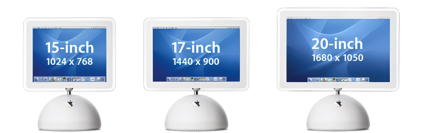
The iMac G4 (officially known as just "iMac", or "The new iMac" when it first came out) is an all-in-one desktop computer which had three different screen sizes... for whatever reason. Released on January 7th, 2002 with the original 15-inch model, it was immediately recognized as a more unique computer compared to anything on the market. The actual computer itself was stored in the "dome", and the screen was attached to a metal arm on the dome that could tilt, swivel, and raise/lower the "floating" screen.
This computer had several hardware revisions throughout its lifespan; each model uses its own motherboard and is not interchangeable with other models, unlike the eMac's 2nd iteration. A 17-inch model was introduced in July of 2002, and a 20-inch model in October of 2003. Ironically enough, the eMac sold much better than the G4 iMac, partly due to the fact that most people found the eMac as a better deal. On August 31st, 2004, the iMac G5 replaced the iMac G4 lineup entirely, with a more practical... and less efficient design. Frankly, no PowerPC all-in-one is safe from issues, it seems.
System Specifications
 Processors:
-Motorola PowerPC G4 7450/7451 700MHz/800MHz (2002, select 2003 models)
-Motorola PowerPC G4 7445 1GHz/1.25GHz (2003)
-15-inch: 1024x768 LCD panel
-17-inch: 1440x900 LCD panel
-20-inch: 1680x1050 LCD panel
-2002 15-inch and "Mac OS X Only" variant: nVidia GeForce2 MX with 32MB of DDR VRAM
-2002 17-inch and 2003 1GHz 15-inch: nVidia GeForce4 MX with 32MB of DDR VRAM
-Early 2003 17-inch 1GHz: nVidia GeForce4 MX with 64MB of DDR VRAM
-Late 2003 17-inch and 20-inch: nVidia GeForce FX 5200 Ultra with 64MB of DDR VRAM
-2002 and Early 2003: PC133 SDRAM, 1 SO-DIMM slot under the base cover and one DIMM slot on the motherboard, supporting up to 1GB.
-1GHz and Late 2003: PC2100 or PC2700 DDR SDRAM, 1 SO-DIMM slot under the base cover and one DIMM slot on the motherboard, supporting up to 2GB.
-2002 and Early 2003: 3.5" Parallel ATA (UDMA/66) Hard Disk Drive
-Late 2003 and DDR models: 3.5" Parallel ATA (UDMA/100) Hard Disk Drive
-5.25" Parallel ATA Optical Disc Drive, CD-ROM/CD-RW/DVD-ROM "Combo"/SuperDrive
-Texas Instruments TAS3004 Audio Chipset
-10/100 Ethernet
-56K V.92 Modem
-3 USB 1.1 ports (USB 2.0 for Late 2003 models)
-2 FireWire 400/IEEE 1394 ports
-Headphone jack and proprietary Pro Speakers jack
-RJ11 Modem Jack
-RJ45 Ethernet Jack
-(Optional) AirPort 802.11b Wi-Fi for 2002 model, AirPort Extreme 802.11g Wi-Fi for select 2003 models
-Mini-VGA Video Output (can be used to extend with a software hack on OS X)
-2002 Only: Mac OS 9.2.2
Note: Mac OS 9 does not officially boot on 2003 models, and late 2003 models with FX 5200 graphics won't get GPU acceleration under OS 9.2.2.
-2002: Mac OS X 10.1.2 to 10.4.11
Note: can run 10.5.8 with LeopardAssist
-2003: Mac OS X 10.2.3 to 10.5.8 (10.4.11 for 800MHz)
Note: 800MHz model can be upgraded to 10.5.8 with LeopardAssist, or by overclocking the CPU.
Note 2: 20-inch models came with Mac OS X 10.3.1 preinstalled.
-MorphOS (select models only)
-OpenBSD PowerPC
-Various PowerPC GNU+Linux distributions, such as Gentoo or Debian
Known Issues
While this was an improvement over the previous generation of iMacs in terms of reliability (especially considering they added a fan to these), they're not without their issues. Thankfully, these issues aren't very common but are further accelerated on some later models like the 17 and 20 inch USB2 models.
Some of these did actually suffer from overheating, but since they had a fan, the issue was very uncommon. It is also likely that this was caused because of the odd nature of the computer, where you will need to reapply thermal paste to the areas near the screw threads when you service the computer. One design flaw that is apparent was the fact that the fan really seemed to cool the hard drive and optical drive more than the CPU... which was not a great idea in execution. It becomes more apparent that Steve Jobs' ideas weren't great for reliable engineering. I did mention on a previous version of this page that the early ones suffered the most from overheating, but it seems as though the early ones are the more reliable models.
Another issue involving these (and especially the 20-inch models it seems) is a power supply failure. The 20-inch is the odd one out here because A. it's the heaviest model, and B. it takes the most power. The 20-inch iMac G4 was really a rushed decision, because in reality it was the 17 inch model with a larger screen tacked onto it. I actually had a weathered 20-inch with a broken screen and damaged frame several years back, and the only differences I've seen with the 17-inch USB2 model and the 20-inch one is the screen. The inverter on the 20-inch is also MASSIVE compared to the 17-inch model, which attributed more to PSU stress, especially in a small enclosed dome. The design worked great for the 15 and 17 inch models, but the 20 inch models showed the design's limitations rather clearly. I know most of this was me rambling on about the 20-inch iMac G4, but it seems as though it's the least reliable model either way. Wish I had one though... but I wouldn't know what I'd use it for.
Thankfully, this was a great step above the cheap inner bezel plastics used on the slot loading G3s and the poor reliability of the PAV board on those. However, the iMac that came after this actually fared much worse.
My thoughts
Honestly, this is a computer Apple will never make again... even though you could say that about ALL of their previous products. The design was rather over-the-top for its time, but honestly... I like it. Sure, it's not the most reliable or conventional design for a computer, but it is a unique one compared to other all-in-ones that were made. It was clear that this didn't do as well as the eMac did, which is quite funny considering the eMac was a computer Apple made in response to the concerns about this one (and well in advance; development started as early as late 2001 for the eMac). The LCD panels aren't the best (especially on early models), but damn, this is honestly cooler than the 20th Anniversary Macintosh, given that computer is a PowerMac 6500 shoved into a flat panel housing with a bunch of weird crap and reliability concerns. I have a 15-inch 2002 model running 10.4.11 and 9.2.2, and while it isn't my go-to G4 mac, it's one that I'm glad to have. It's not the best one around, but it's a great example of one and I don't think I'll part with it anytime soon.
This design was one of the more short-lived iMac designs out there, as a whole. The next generation of iMacs took a simpler approach, and attracted way more buyers than the eMac did when the iMac G4 was out.
